
A Pride Month Post from Dr. Kimberly Williams
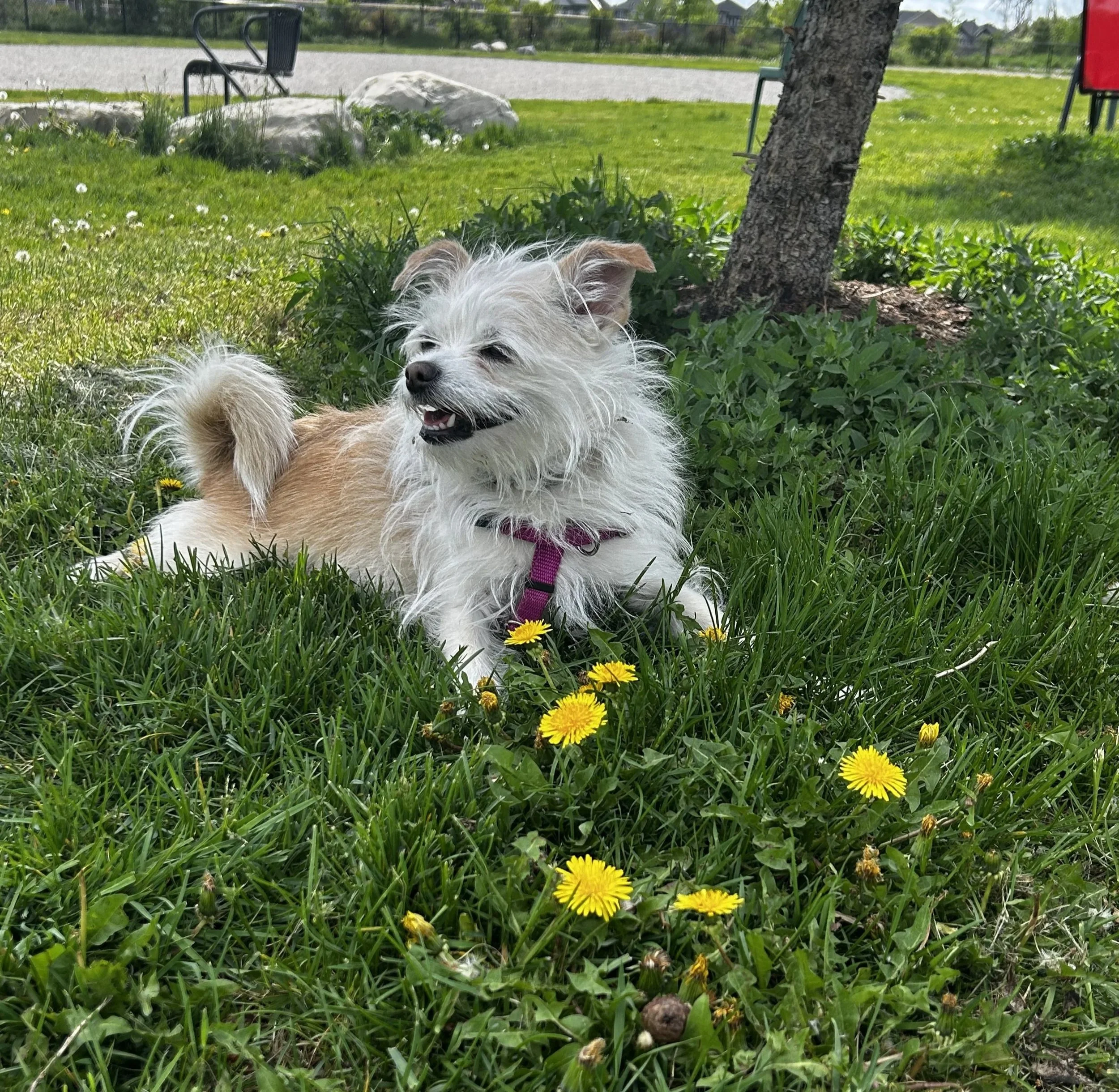
Sunshine the scruffy dog rests in the shade amidst some dandelions, mushrooms, and grass, watching the world go by.
My partner and I recently moved into a new-to-us condo complex, and our neighbours, it turns out, take the grounds very seriously — to the extent that an annual delivery of community dirt seems to be included in our monthly HOA fee to support everyone making their yards beautiful. Now, I’m not complaining; my plan for next year, once we’re settled, is to turn our small front yard into a bee sex palace.
But spring had barely sprung here this year on the banks of the Ottawa River, in unceded, unsurrendered Ashinaabe Algonquin territory, before crews were out daily, coaxing every blade of grass into line, routing out any cheeky flora that volunteered itself without permission.
My pup, Sunshine, and I watch the crews every morning from the front steps. I appreciate their dedication; she warns me if they get too close. And we both notice during our afternoon walks that, without fail, something small and yellow is already pushing back through, despite their Herculean efforts.
Because the dandelions couldn’t care less and don’t ever ask permission.
—
I learned the word weed before I learned the word queer, but they taught me the same thing: you are growing in the wrong place.
Both words, I only much later understood, are political. Not botanical. Not biological. Not natural. Just white supremacist capitalist cisheteropatriarchal power, deciding (yet again) what belongs and what doesn’t, and trying to cloak that decision in the authority of nature to make it feel inevitable.
But it was never inevitable. Botanical taxonomy, invented to facilitate the so-called Age of Imperialism, was not neutral science. It was colonial infrastructure, a way of naming the living world so it could be owned.
Here, though, is what a weed actually is: a plant that survives where it isn’t supposed to.
That’s it. That’s the whole definition. There is no committee of botanists who have declared certain plants inherently more “weedy” than others. The dandelion growing through the pavement crack is not failing at being a plant. Quite the opposite, in fact. It is succeeding, spectacularly, at being alive in conditions designed to exclude it.
Sound familiar?
Before colonization reshaped both land and understanding, many cultures held what we might now call “queer” people as integral. These folks weren’t “tolerated.” They were not considered exceptional, but necessary. Two-Spirit people across many Indigenous cultures held specific ceremonial, social, and spiritual significance. Gender and sexual multiplicity were not problems to be managed. They were a crucial part of the balanced whole.
Settler colonialism imposed a taxonomy. It decided which plants were useful and which were weeds. Which bodies were legible and which were deviant. Which ways of loving were natural and which were disordered. These were the same project, carried out with the same logic, across the same 500+ years.
What gets called “invasive” is often that which simply refuses to disappear.
Take purslane. You’ve almost certainly walked past it as it grows low and succulent, in the dry cracks of sidewalks and neglected lots. Here in Canada, purslane is classified as a common weed. But for some Indigenous communities here on Turtle Island and across Southwest Asia and North Africa, it is food, medicine, a plant with deep cultural roots. Its “weediness” is entirely a matter of whose land you are standing on, and whose knowledge counts.
Take clover. For centuries a welcome part of meadows and even lawns, until the 1950s when new broadleaf herbicides couldn’t distinguish it from plants the fertilizer industry wanted gone. So that industry, the backbone of what is now known as agribusiness, reclassified it. Clover became a weed not because anything about clover changed, but because the system needed it to be eliminable. It was made into a weed by the very forces trying to kill it.
As queer folks, we know this story. We live this story. Every day.
But here’s the thing about weeds. It’s the same thing that the lawn, the herbicide, the centuries of effort have not been able to change:
They/we keep growing.
Not because they/we are “aggressive,” or “invasive,” or any of the other words that get borrowed from ecology and applied, not coincidentally, to marginalized human communities. But because they/we are generalists. Adapters. Opportunists in the most magnificent sense! They/we are alive to the edge, the crack, the disturbed soil, the place where the careful order breaks down and something else becomes possible.
Ecologists call it the edge effect. The boundary between two ecosystems (e.g., forest and meadow, land and water, manicured and wild) is where biodiversity explodes. The margin is not the least alive place. It is the most.
Queer people have always known how to live at the edges. We’ve always found the crack in the pavement, the gap in the fence, the abandoned lot where something extraordinary is quietly happening. This is not a consolation prize for exclusion. This is a skill. This is knowledge. This is resilience so deep it looks, to those not paying attention, like simply being a weed.
Resilience, I want to be clear, does not mean bouncing back. Bouncing back implies returning to a previous shape, but that shape was never ours to begin with. Queer resilience is not the resilience of the trimmed hedge that regrows after cutting. It is the resilience of the dandelion, which does not regrow into some manicured lawn plant. It grows back into itself, bright and irreducible, releasing a hundred seeds on the wind before those landscaping crews can reach for their mowers.
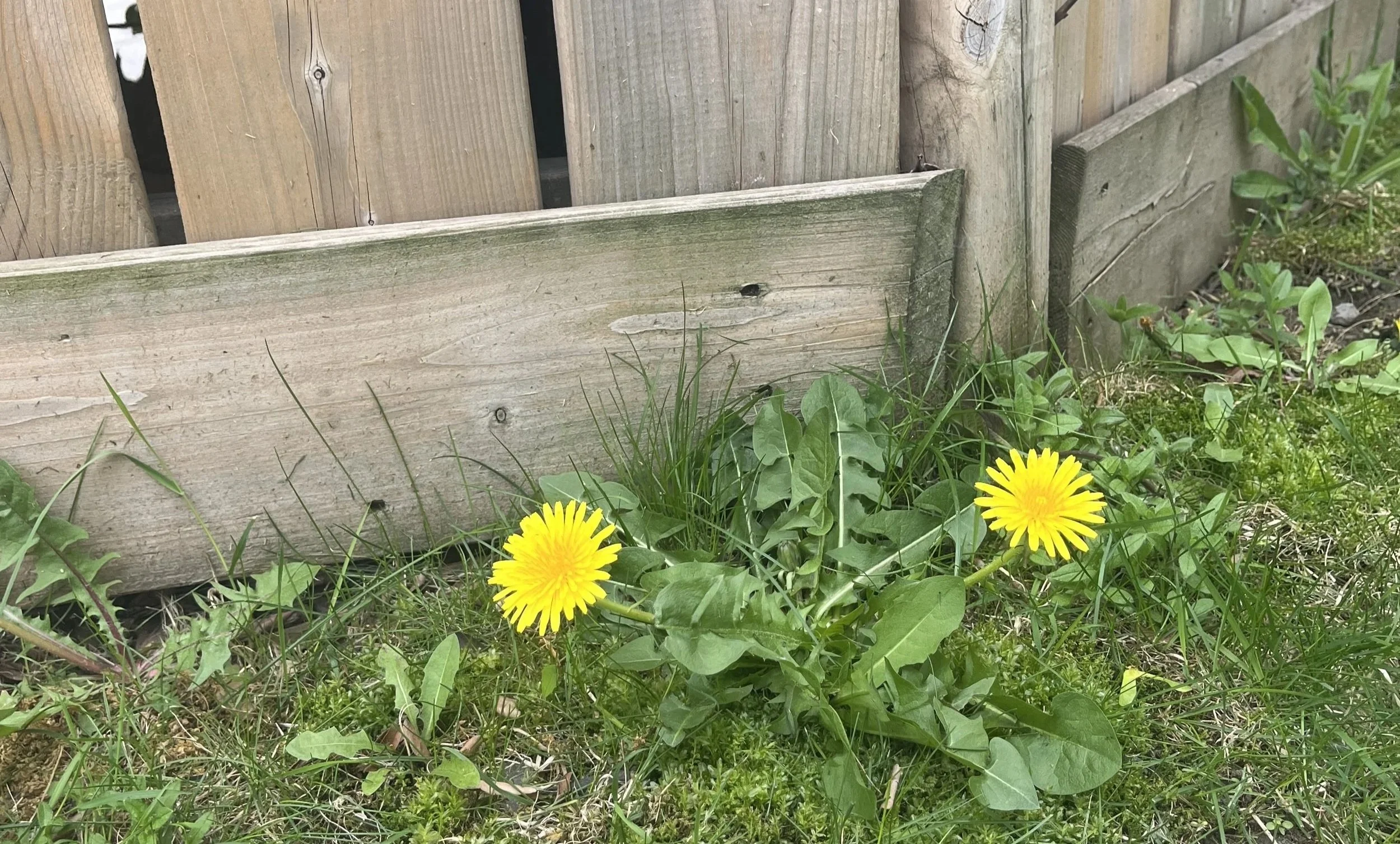
MANY dandelions sprout along a wooden fence line… “bright and irreducible.”
We survive not in spite of our queerness but because of it. The same qualities that have been policed, pathologized, and pruned — our fluidity, our refusal of neat categories, our ability to grow sideways and find nourishment in unlikely places — are exactly what keep us alive. Adaptation without assimilation. Persistence without permission.
The non-human world has been doing this forever.
And that world has never been straight.
Not even a little. The non-human world (the one that existed before the lawn, before the herbicide, before the taxonomy of deviance) is extravagantly, riotously queer.
Clownfish change sex in response to their community’s needs. Albatrosses pair for life, and a remarkable number of those pairs are two females raising chicks together. Slime molds have no fixed form; they move, merge, separate, become something else entirely. Fungi don’t have sexes the way we understand them; some species have thousands of mating types, each able to reproduce with most of the others. Aspen groves that look like individual trees are a single organism, one root system, one ancient being wearing thousands of bodies.
This is not a metaphor. This is just what life actually does when nobody is managing it.
That’s how we can be sure that the sex/gender binary was always fiction. Queerness was always the ground. And queer people, like the dandelions, will always come back, despite the best efforts of those who wish to ignore, erase, or eradicate us.
Do you know what this means?
It means that nature is waiting for you. Not as therapy, not as concept, but as recognition: the specific, cellular relief of being seen by something that has always known what you are. The soil that has composted a thousand seasons of things that were supposed to be gone. The mycelium underneath everything, trading nutrients in the dark, caring for trees the forest has already decided are dying. The weed in the crack that chose that exact, impossible spot and bloomed there anyway.
___
Again tomorrow morning, Sunshine and I will sit on the front steps and watch the crews work. Again tomorrow afternoon, we’ll walk past what they’ve done. And again, without fail, something yellow will pop back up through the careful, managed, HOA-approved grass.
Dandelions don’t have a strategy. They don’t have a movement, a manifesto, or a five-year plan. They have something older and more stubborn than any of that: the simple, cellular insistence of a living thing that knows it belongs. That has always known. That will still know long after the landscaping crews pack up and the blowers go quiet.
The non-human world has been queer since before the word existed. It has been fluid, excessive, boundary-refusing, and gloriously unmanageable since long before anyone arrived with a colonial taxonomy and a lawn mower. The binary was always the imposition. The dandelion was always the truth, and truth doesn’t need permission to exist.
That’s not a mood, my friend. That’s a summons.
So, today — right now if you can! — go find a dandelion. Say hello. Ask what lessons it has for you. It’s been here longer than either of us, and it has things to teach.
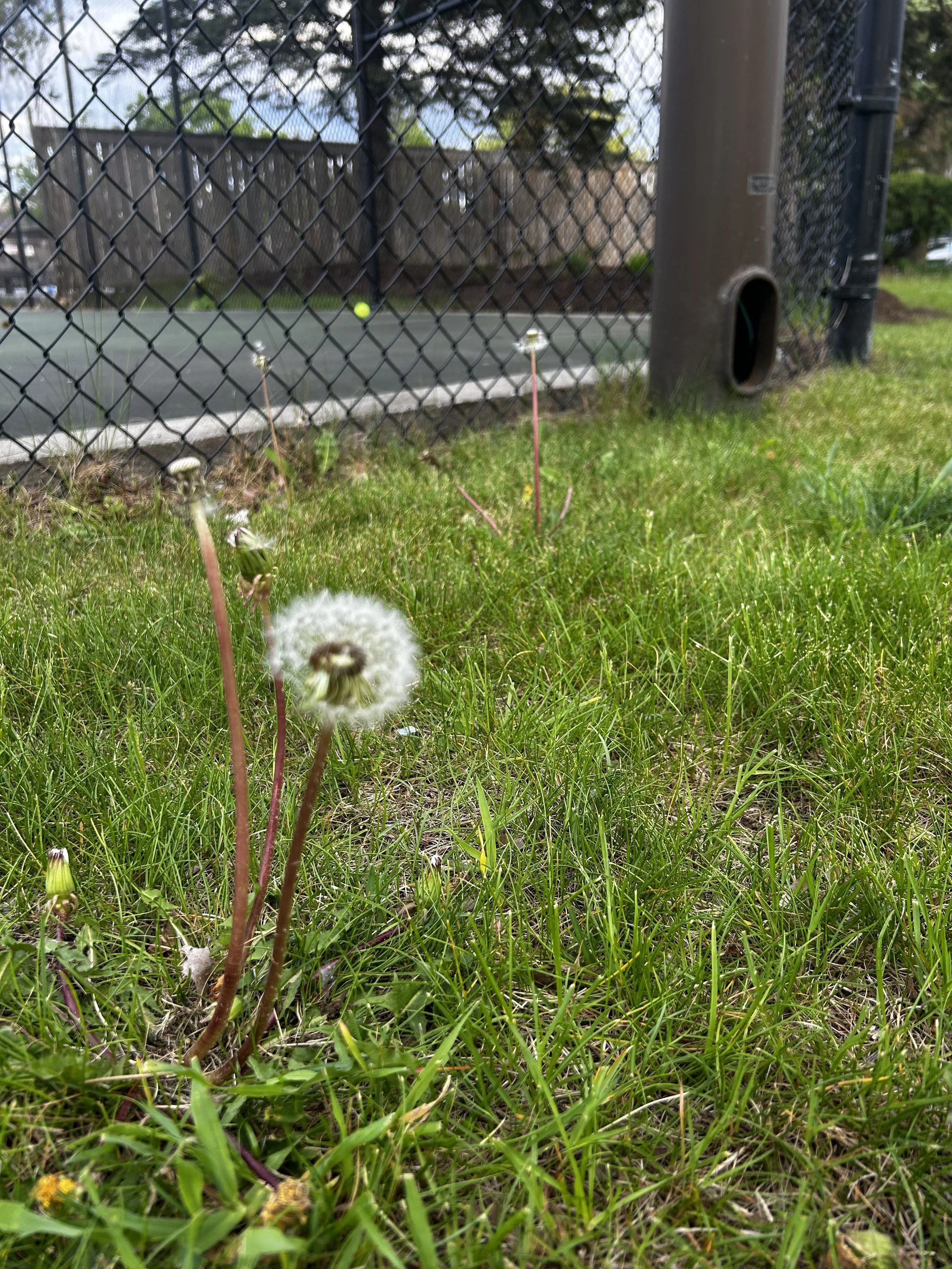
Dandelions gone to seed along a chain link fence in front of a parking lot. Going for it.
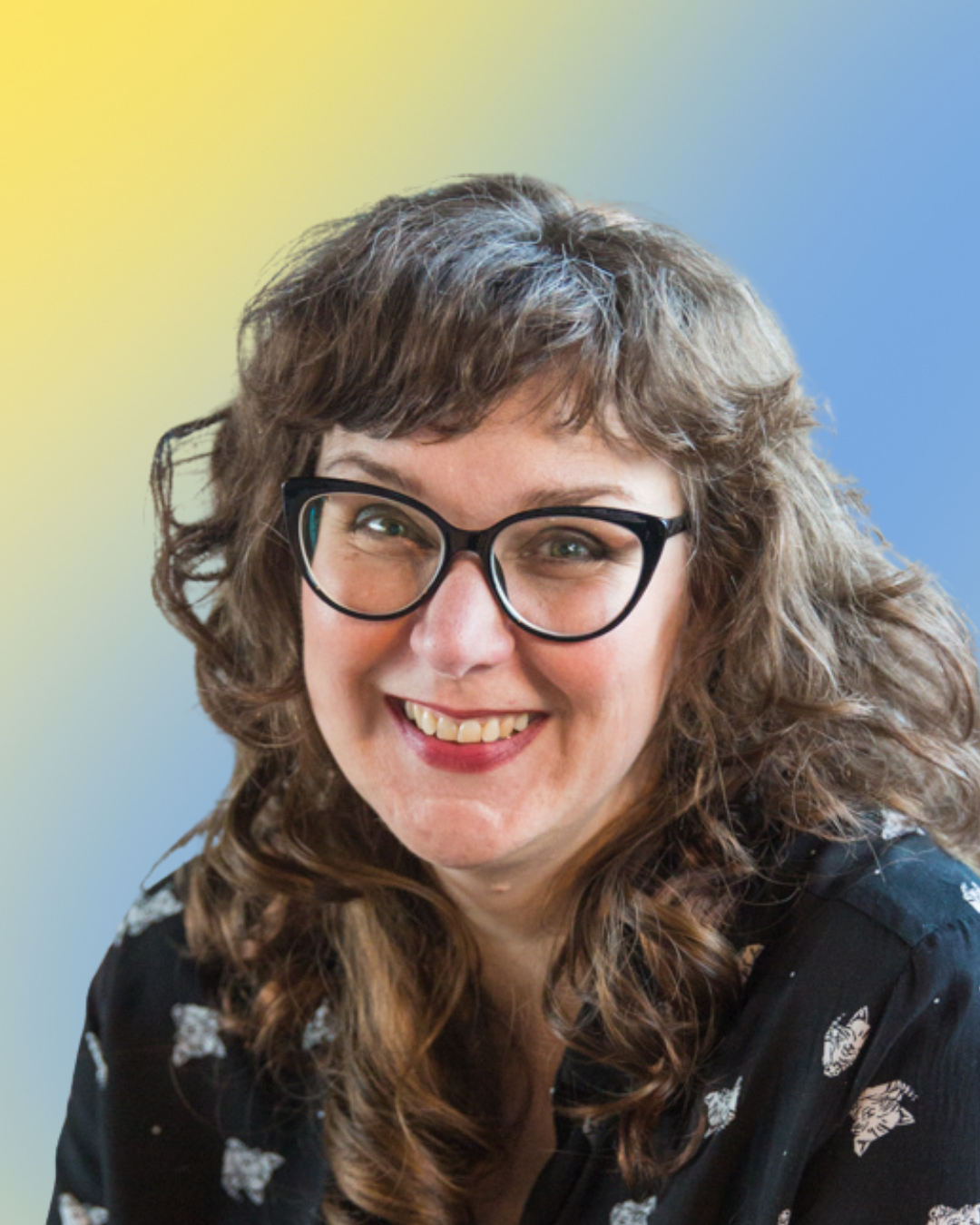
Dr. Kimberly Williams is a clinician here and teaches. She is an amazing writer who frequently contributes to our blog.
Find her other posts here:
Trans People Aren’t The Problem
Back to School After the Holidays
Constitutional Power as Systemic Violence
You can learn more about her as a clinician and book a free initial consultation with her here.