I Study Gender-Based Violence, and Trans People Aren’t the Problem
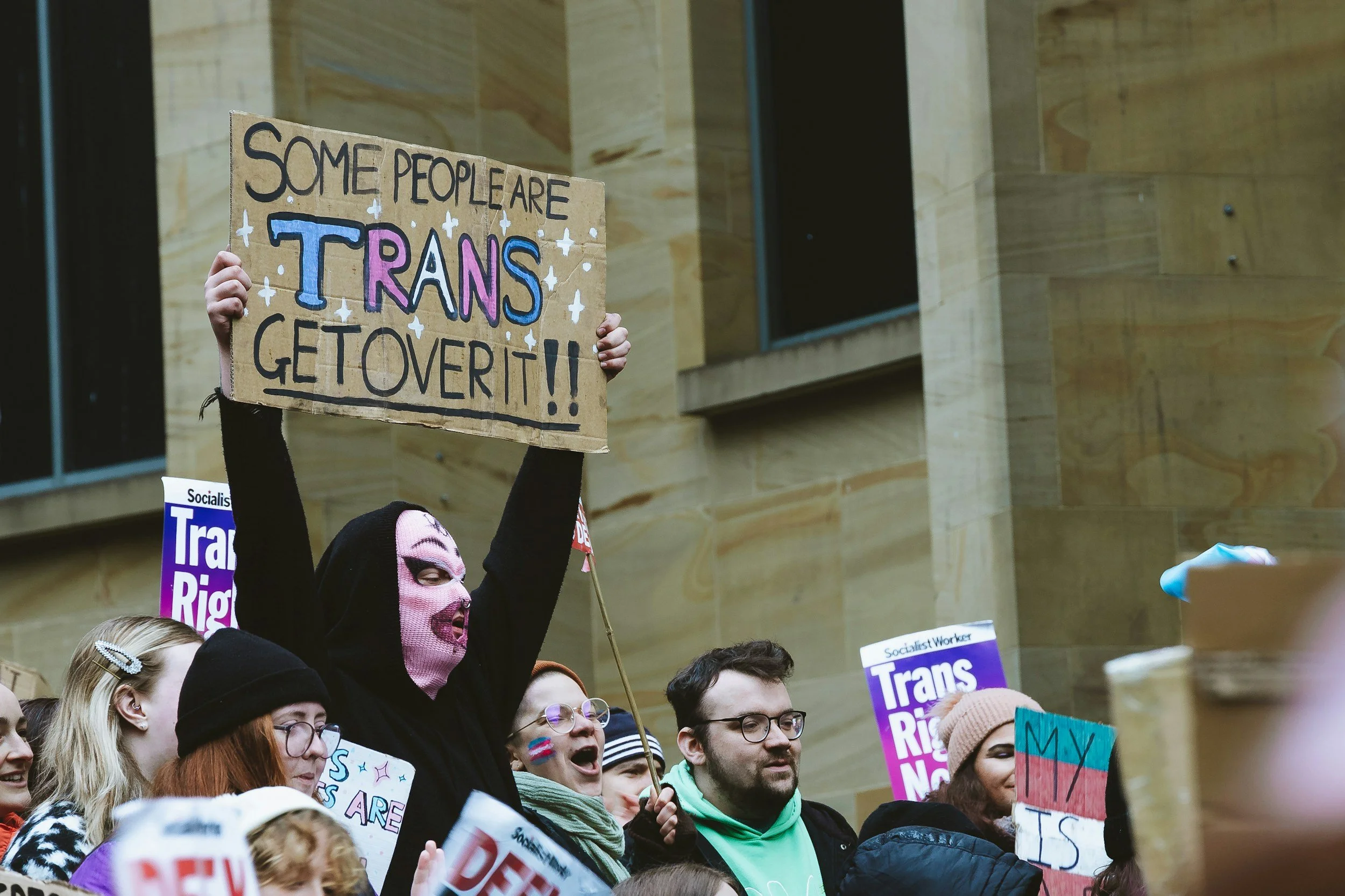
A scene from a Trans Rights protest - one person from the crowd holds a sign up high that says “Some people are trans. GET OVER IT!!”
by Kim Williams
(check out her presentation on supporting partners to Trans folks at the upcoming Queering Mental Health Conference!)
On this Trans Day of Visibility, I'm sitting at my desk with my morning coffee, doing what I always do on days like this: taking stock. Bearing witness. Asking the questions that 25+ years as a feminist scholar-activist have trained me never to stop asking. Questions like: who benefits from the stories we're told? Who gets hurt by them? And who, exactly, is being protected, and from what?
Because apparently, I need protecting.
This is what governments around the world — and increasingly here in Canada — would have me believe when they pass legislation restricting trans people's access to bathrooms, healthcare, and basic legal recognition. Indeed, my home province of Alberta has been leading this particular charge with considerable enthusiasm. Under Premier Danielle Smith’s UCP government, the province has banned gender-affirming care for minors, introduced rules requiring parental notification when students use different names or pronouns at school, and moved to bar trans girls and women from sports categories that match their gender identity. New Brunswick and Saskatchewan have enacted similar parental notification policies.
And in each case, the justification offered is some version of the same thing: we are doing this to protect women and girls.
I used to be a girl. I am now a cisgender, middle-aged, white settler woman. I am, in theory, exactly who these policies are designed to protect.
But on this Trans Day of Visibility in 2026, I want to unequivocally state that I do not want this protection. I did not ask for it. And I don’t need it.
Instead, let me tell you what actually threatens my safety and wellbeing as a woman. And I’ll give you a hint: It is not trans people.
It has never been trans people. In twenty-five years of feminist teaching and scholarship, and several years of community mental health practice, I have never once encountered credible evidence suggesting that trans people pose a danger to cisgender women.
What I have encountered, relentlessly and heartbreakingly, is evidence of the staggering, normalized, and largely unaddressed scale of cisgender men’s violence against women.
In Canada, a woman is killed by a current or former intimate partner every six days. Indigenous women and girls are murdered and disappeared at genocidal rates. One in three Canadian women will experience sexual assault in her lifetime. And the 10-year National Action Plan to End Gender-Based Violence was only launched in late 2022, despite recommendations made since at least 1970 by feminist organizations, survivors, and anti-violence advocates.
Read that again. It took more than fifty years to create a (terribly problematic) National Action Plan to end men's violence against women in Canada. But there is apparently sufficient political will, public money, and legislative energy to debate whether a trans girl belongs on a softball team.
If that does not register as a profound moral inversion, I genuinely do not know what will.
Feminists have long called out the weaponization of women’s safety by the very systems that have not only never meaningfully prioritized that safety, but actually jeopardize it. I've written elsewhere about the specific mechanisms by which this misdirection operates — about how violence gets pathologized when trans people are involved and individualized when cis men are the perpetrators, and about what that double standard reveals about masculinity as a structural driver of violence.
Cisheteropatriarchy has always needed a folk devil, a threat it can point to in order to consolidate its own authority and deflect accountability for its own violence. Trans people, and trans women in particular, are the current preferred target. But this is not about protecting women. It is about enforcing the rigid, binary, hierarchical gender norms that have always been the primary architecture of our collective oppression.
The Vancouver-based artist, author, and activist Vivek Shraya has written and spoken about this with characteristic brilliance in I’m Afraid of Men: transphobia and misogyny are not separate phenomena operating in isolation from one another. They are expressions of the same underlying logic, doing the same work, in adjacent rooms. The policing of trans bodies is the policing of all bodies that refuse to conform to the sex/gender binary (e.g., that deeply familiar, deeply coercive system that sorts human beings into just two acceptable categories and then expends enormous energy punishing anyone who doesn’t fit neatly into either one).
When a government legislates a trans child’s identity out of existence, it is drawing on the same ideological well that told generations of women that their ambitions were illegitimate, their pain exaggerated, and their testimony not to be trusted.
This is not coincidence. This is the imperialist white supremacist capitalist cisheteropatriachal (a.k.a. settler colonial) system working exactly as designed.
And we cannot have this conversation in Canada without talking about settler colonialism, because the sex/gender binary is a project of settler colonialism. Many Indigenous nations across Turtle Island have always recognized and honoured gender diversity as a sacred and vital dimension of human experience. Two-Spirit people held — and continue to hold — respected and spiritually significant roles in their communities. It was the machinery of European colonization, armed with Christian missionary certainty and a rigid sex/gender binary imported wholesale from the Old World, that criminalized gender diversity on this land. That pathologized it. That tried, with considerable violence, to eradicate it.
The current legislative attacks on trans people are not, therefore, a defense of tradition or nature or common sense, whatever their architects claim. They are a continuation of a specific colonial tradition: the violent enforcement of European gender norms on bodies that have always refused them. Indigenous bodies. Racialized bodies. Trans bodies. Queer bodies. Disabled bodies. Women’s bodies. The project has always been the same. Only the targeted bodies change.
Kai Cheng Thom, the Montreal-based writer, poet, and community worker whose thinking I find myself returning to again and again, writes about the ways trans communities, and trans women of colour especially, carry the compounded weight of these interlocking systems. To stand with trans people is not a distraction from feminist and anti-colonial work. It is constitutive of it.
Meanwhile the world is legitimately on fire. Climate change is accelerating beyond the most alarming projections of a decade ago. Wars are proliferating. In the United States, the systematic dismantling of reproductive rights is generating devastating ripple effects already being felt across our border and around the world. Poverty is deepening. Hate crimes are rising. And governments that have somehow never managed to find the political will or the budget to fund adequate shelters for women fleeing violence, or clean drinking water for Indigenous communities, or accessible mental healthcare for people who desperately need it, have found the will, the appetite, and apparently the time to make life measurably harder for some of the most vulnerable people in our communities.
The audacity of it is, at this point, almost breathtaking.
Almost. But not quite. Because those of us who have been paying attention know that this is exactly how cisheteropatriarchy and settler colonialism have always operated: by manufacturing crises, pointing at the wrong people, and counting on our exhaustion and our division to do the rest. Keep us looking over there so we don't look over here. Keep us afraid of each other so we don't ask who actually benefits from our fear.
So on this Trans Day of Visibility, I want to say something simple and I want to say it clearly:
I see you. I am with you.
The Black feminist tradition in which I was trained includes: Audre Lorde, who reminded us that we do not live single-issue lives; Angela Davis, who teaches that liberation is always and necessarily collective; bell hooks, who insisted that love and justice are not opposing forces but the same force moving in the same direction. That tradition has always known that none of us are free until all of us are free. That understanding has not aged. It is not up for revision. And it is non-negotiable.
The people who claim to be protecting me have never protected me. They have never protected most of us. What they are protecting is a set of power relations built on the control of bodies, the enforcement of norms, the management of difference, and the distribution of resources accordingly. This set of power relations, which bell hooks critiqued as imperialist white supremacist capitalist cisheteropatriachy and Indigenous people call settler colonialism, has been sustained for 500+ years at our collective expense.
Trans rights are not in conflict with women’s rights. They never were.
That has always been a lie, told by people who need us divided and afraid of each other, because they know what we can become when we aren’t.
So if you’ve read this far and you’re a cisgender woman who refuses division and manufactured fear, start by supporting Queer Momentum's Not In Our Name campaign, a Canadian coalition of ciswomen and feminists standing together in explicit, public support of trans rights. This is what solidarity looks like in action.
Happy Trans Day of Visibility.
We have work to do.
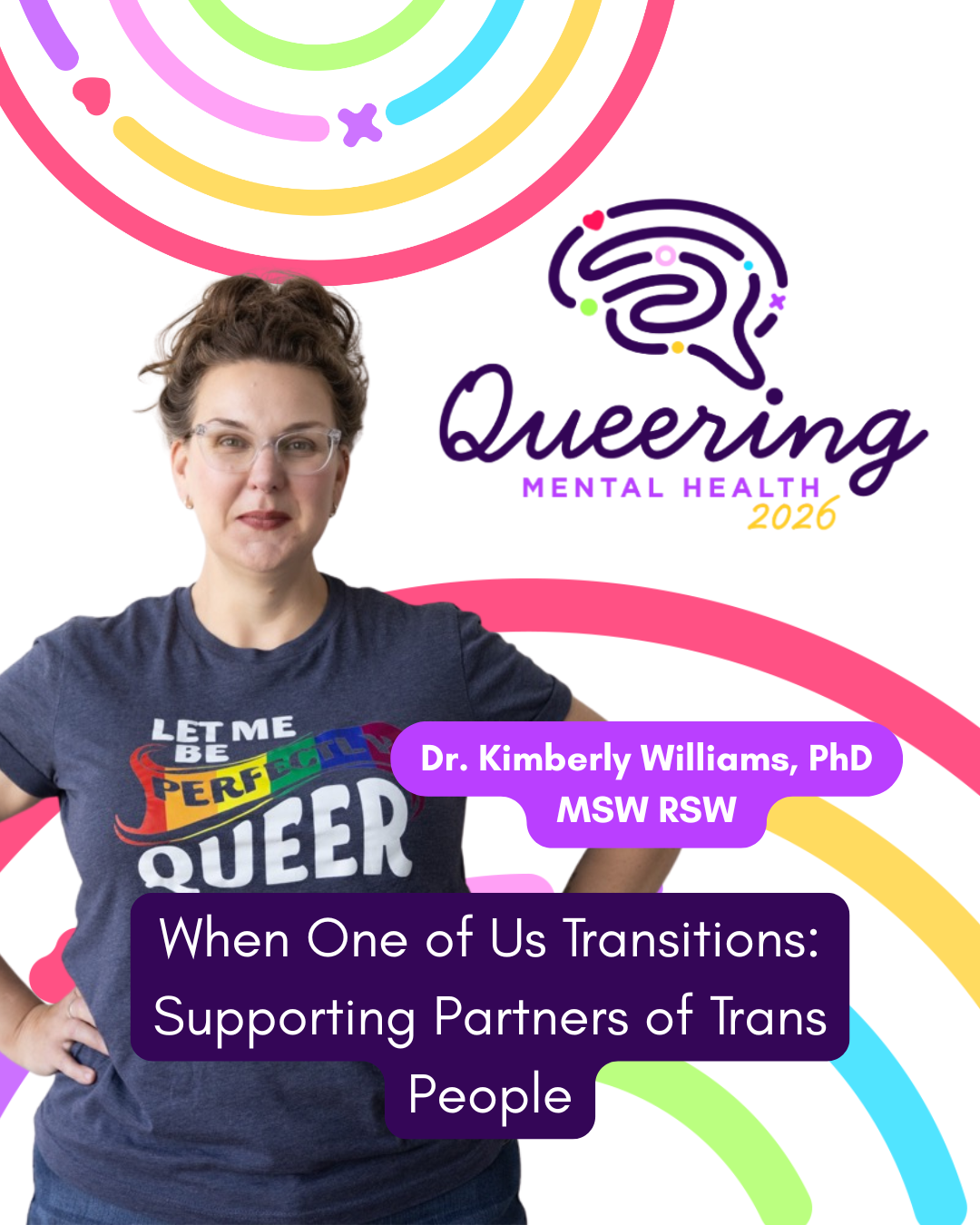
Meet Kim
Dr. Kimberly Williams (PhD, MSW, RSW) is a clinician here at Our Landing Place, as well “a queer, fat, feminist, white settler therapist with proud working-class roots and a deep love for stories—especially the ones we tell ourselves, rewrite, and reclaim.” She often writes amazing blogs here and is a presenter at our upcoming Queering Mental Health Conference!